Gil R.
Posts: 10821
Joined: 4/1/2005
Status: offline

|
Okay, here it is, with just minor changes:
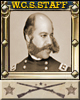
Brig. Gen. John Rogers Cooke (b. 1833, d. 1891). Cooke was from a family divided by the war: his father was a Union cavalry commander Maj. Gen. Philip St. George Cooke and his brother-in-law was Confederate Maj. Gen. J.E.B. Stuart. He was born on June 10, 1833 at Jefferson Barracks, Missouri. In 1854, Cooke graduated from Harvard University, where he studied civil engineering. After college, he served as an engineer for the Iron Mountain Railroad in Missouri, but later that year joined the army and was appointed to lieutenant. Cooke served in the Southwest until Virginia seceded from the Union in April 1861, whereupon he resigned his commission and then traveled to Virginia to report for duty. Cooke was made a 1st lieutenant and headed to Fredericksburg, soon serving with the troops from Aquia Creek, Virginia at the Battle of First Bull Run on July 21. Following the battle, Cooke formed a company of light artillery and served along the Potomac River. In February 1862, he was promoted to major and sent to serve in the Department of North Carolina as chief of artillery. Cooke was elected colonel of the 27th North Carolina Infantry in April, and the regiment was sent to Virginia and attached to Gen. A.P. Hill’s Division, in which it saw action during the Peninsula Campaign and the Seven Days’ Campaign. During the Battle of Antietam, Cooke led his men (along with the 3rd Arkansas Regiment) on an attack between the Dunkard Church and Sunken Road. The attack was eventually repelled by Union reserves entering the fight. Cooke fell back and was ordered to form a defensive line to hold off any Union advance, to which he replied that though they had no ammunition, he would stay where he was as long as he had a man or a bayonet left. Cooke was wounded during the battle but stayed on the field and earned praise for his command. Six weeks later, on November 1, he was promoted to brigadier general and given command of a brigade of North Carolina regiments. During the Battle of Fredericksburg on December 13, 1862, Cooke was wounded by a bullet to the forehead while his brigade supported Brig. Gen. Thomas R.R. Cobb’s brigade in the defense of the stone wall at Marye’s Heights. Cooke recovered and returned for duty the following April. Later that year, on October 14, he received another serious wound at the Battle of Bristoe Station. This time it was his leg that was hit, taking him out of action until he returned in time for the beginning of the Overland Campaign in May 1864. During this campaign, Cooke and his brigade fought with the III Corps in Maj. Gen. Henry Heth’s Division at the Wilderness and Spotsylvania Courthouse, where he was wounded once again. In all, Cooke was wounded seven times during the Civil War. On August 25, 1864, he led his brigade during the Second Battle of Reams’s Station, one of the engagements in the Siege of Petersburg, and thus helped to rout the Union’s II Corps. Cooke’s last battles where at Sutherland Station, where he temporarily stopped the Union breakthrough on April 2, 1865, and then at finally at Appomattox. After the war, Cooke lived in Richmond, where he was a merchant and was involved in the chamber of commerce, Democratic Party, and board of directors of the state penitentiary, and co-founded the Confederate’s Soldiers Home in Richmond. On April 10, 1891, Cooke passed away and was buried in Richmond’s Hollywood Cemetery. (Bio by Andrew Thayer)
Leadership: 5
Tactics: 5
Initiative: 3
Command: 3
Cavalry:
Teaches: Disciplined (1), Random (-1)
Start date: 44
(By the way, FOF can be ordered as boxed CD's -- it's no longer only available by download. I'm torn whether to tell you this, in case it means that playing the game leaves you less time for bios...)
|
 Printable Version
 Brig Gen John Rogers Cooke -


 New Messages
 No New Messages
 Hot Topic w/ New Messages
 Hot Topic w/o New Messages
 Locked w/ New Messages
 Locked w/o New Messages
 Post New Thread